

Edgar Degas Paintings: Ballet, Modern Life and Movement in Art
Edgar Degas: Paintings of Movement, Modern Life and the Ballet
Edgar Degas is best known for his images of ballet dancers, but his art reaches far beyond the stage. Across paintings, pastels and drawings, he captured the rhythms of modern Paris: rehearsals, cafés, theatres, racecourses and private moments at home. His subjects may seem casually observed, yet his carefully arranged compositions reveal an artist who thought deeply about movement, light and the act of looking.
Who was Edgar Degas?
Hilaire-Germain-Edgar Degas was born in Paris in 1834 and died there in 1917. He trained in traditional art, studying the work of earlier European masters, but became one of the most distinctive artists associated with Impressionism. The label never entirely suited him: unlike many Impressionists, he often preferred working indoors, drawing from memory and using carefully constructed compositions.
Degas worked in oil and pastel, as well as in drawing and sculpture. He returned repeatedly to a small number of subjects, exploring them from different angles rather than simply recording a scene once. His paintings are recognised for their unusual viewpoints, cropped figures and sense of movement—qualities that can make a moment appear both spontaneous and precisely staged.
Dancers beyond the spotlight
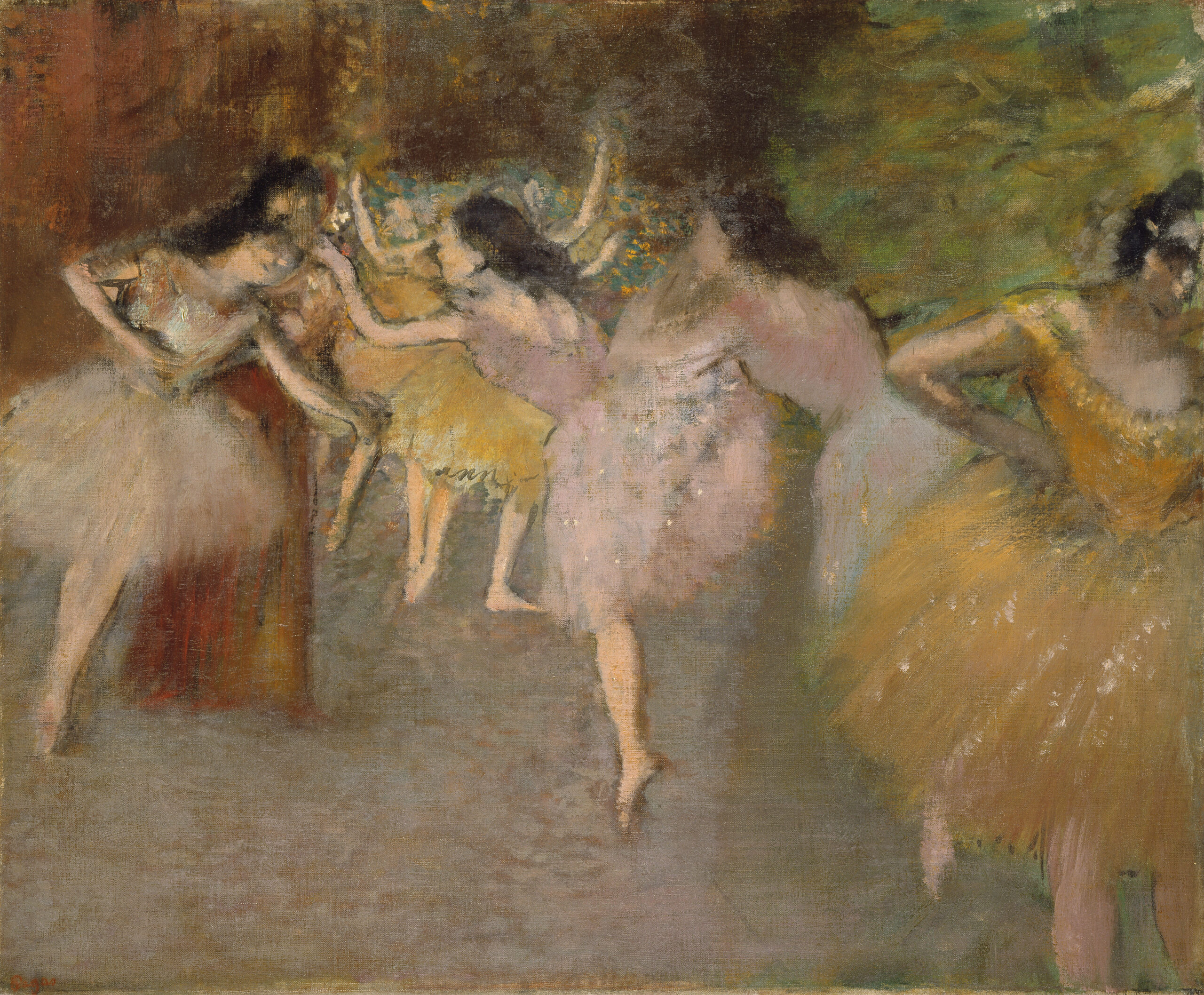
Ballet dancers are among Degas’s most familiar subjects. Works such as The Dance Class (c. 1874) show dancers practising under the watchful eye of a ballet master. Rather than focusing only on a performance, Degas depicts the work behind it: stretching, waiting, adjusting costumes and repeating steps.
This attention to rehearsal gives the paintings their distinctive tension. Dancers bend, turn or pause at the edge of the composition, while the room itself seems to continue beyond the frame. The result is not simply a celebration of ballet’s grace. It also suggests the discipline, fatigue and routine behind the polished spectacle.
Scenes from everyday life
Degas also painted people in cafés, theatres, workplaces and domestic interiors. In L’Absinthe (1875–76), two figures sit at a café table, absorbed in their own thoughts. The subdued palette and disconnected expressions create an atmosphere of isolation, offering a more complex picture of urban life than a straightforward social scene.
In A Cotton Office in New Orleans (1873), Degas depicts members of his family in a workplace. The composition draws attention to individual gestures and relationships, as well as to the varied activities taking place across the room. It demonstrates his interest in observing people as they occupy real, functioning spaces.
Composition, colour and movement
One of the most striking features of Degas’s paintings is their composition. Figures may be cut off by the edge of the canvas, viewed from above or placed at an unexpected distance. These choices give the impression that the viewer has arrived in the middle of an event. They also reflect the visual changes taking place in nineteenth-century Paris, where photography and Japanese prints offered artists new ways to think about framing and perspective.
Degas’s handling of colour and surface changed throughout his career. He often combined confident drawing with loose, energetic marks, particularly in pastel. In paintings of dancers, contrasting colours and repeated lines can suggest the sweep of a skirt or the turn of a body. The figures feel caught in motion, but the structure of the image remains carefully controlled.
A complex legacy
Degas remains an influential and sometimes challenging artist. His work rewards close attention: a seemingly casual arrangement may contain subtle relationships between figures, while an unfamiliar viewpoint can alter the mood of an entire scene. His paintings also invite questions about who is being observed and from what position—questions that are particularly significant in works depicting women at work or in private settings.
More than a painter of ballet, Degas was an exacting observer of modern life. His art combines movement with stillness, intimacy with distance, and spontaneity with careful design. That balance is what continues to make his paintings compelling to audiences today.
Exploring the Artistry of Edgar Degas: Answers to 9 Frequently Asked Questions
- What are the four main features of Degas painting?
- When did Degas go blind?
- What was Degas famous for?
- What is Edgar Degas’ most famous piece?
- Where can I see Edgar Degas paintings?
- What is Edgar Degas famous for?
- What kind of paintings did Edgar Degas paint?
- What is the saddest painting of all time?
- Why is Degas so famous?
What are the four main features of Degas painting?
Four key features of Edgar Degas’s paintings are their focus on movement, unusual compositions, scenes of modern life and expressive use of colour. He often portrayed dancers in rehearsal, capturing gestures and fleeting moments rather than only the finished performance. Figures may be cropped by the edge of the canvas or viewed from unexpected angles, giving the scenes a spontaneous feel, while his skilful use of colour, light and pastel brings texture and energy to the work.
When did Degas go blind?
Degas did not suddenly go blind at a specific moment. His eyesight began to deteriorate in the 1870s, and the problem worsened over the following decades, making it increasingly difficult for him to work with fine detail. In later life, he relied more on large-scale forms, bold colours and sculpture, and was nearly blind by the time he died in 1917.
What was Degas famous for?
Edgar Degas was best known for his paintings, drawings and pastels of ballet dancers, particularly scenes of rehearsals and life behind the scenes. He also depicted racehorses, café-goers and other subjects from modern Parisian life. Celebrated for his keen observation of movement and his striking, often unconventional compositions, Degas is associated with the Impressionist movement, although his carefully planned approach set him apart from many of its artists.
What is Edgar Degas’ most famous piece?
Edgar Degas is perhaps best known for his paintings of ballet dancers, particularly The Dance Class (c. 1874), which captures the discipline and bustle of a rehearsal. His most famous work overall may be Little Dancer of Fourteen Years, but that is a sculpture rather than a painting. Other celebrated paintings include L’Absinthe and The Star.
Where can I see Edgar Degas paintings?
Edgar Degas’s paintings can be seen in major museums around the world, including the Musée d’Orsay in Paris, the National Gallery of Art in Washington, DC, and the Metropolitan Museum of Art in New York. In the UK, check the National Gallery and other public collections for works or exhibitions; displays can change, so it is best to confirm current listings on a museum’s website before visiting.
What is Edgar Degas famous for?
Edgar Degas is best known for his paintings and pastels of ballet dancers, which capture both the grace of performance and the hard work of rehearsals. A leading artist of 19th-century Paris, he also depicted racehorses, theatre scenes and everyday life, using unusual viewpoints, cropped compositions and a strong sense of movement.
What kind of paintings did Edgar Degas paint?
Edgar Degas painted a wide range of subjects, although he is best known for his scenes of ballet dancers in rehearsals and performances. He also depicted everyday life in Paris, including cafés, theatres, racecourses and women at work or at home. Working mainly in oil and pastel, Degas was especially interested in movement, gesture and unusual viewpoints, giving many of his paintings a candid, modern feel.
What is the saddest painting of all time?
There is no definitive “saddest painting of all time”, as reactions to art are deeply personal. Among Edgar Degas’s works, L’Absinthe is often regarded as especially melancholy: its two café-goers sit side by side yet seem emotionally distant, surrounded by muted colours and an atmosphere of isolation. Rather than telling a clear story, the painting leaves viewers to reflect on loneliness and urban life.
Why is Degas so famous?
Edgar Degas is famous for his distinctive paintings, pastels and sculptures, particularly his depictions of ballet dancers and everyday life in 19th-century Paris. Rather than concentrating solely on the glamour of the stage, he showed the discipline and effort behind a performance, often using unusual viewpoints, cropped compositions and lively marks to suggest movement. His innovative approach helped shape modern art and continues to make his work instantly recognisable.