

Keith Haring Art: The Bold Visual Language That Changed Modern Art
Keith Haring’s Art: Energy, Symbols and Social Change
Keith Haring’s art is instantly recognisable: bold black outlines, vivid colours and lively figures that seem to dance, crawl or leap across the page. Beneath its playful energy, however, lies a serious body of work concerned with power, inequality, sexuality, public health and the possibility of human connection.
Haring (1958–1990) became one of the defining artists of New York’s downtown scene in the 1980s. He brought the visual language of street culture into galleries and museums, while continuing to make art in public spaces and for a broad audience.
From the subway to the gallery
Born in Reading, Pennsylvania, Haring moved to New York in 1978 to study at the School of Visual Arts. The city’s graffiti, music and independent art scenes helped shape his approach. In 1980, he began drawing with white chalk on the blank black panels of unused advertising spaces in the New York subway. These quick, public works became known as his subway drawings.
Haring made hundreds of them over the following years. Commuters encountered the drawings as part of everyday life, rather than in a gallery. Their directness was central to their appeal: a few confident lines could suggest a whole figure, creature or scene. The subway also gave Haring a place to experiment, develop recurring symbols and meet an audience beyond the art world.
A visual language of movement
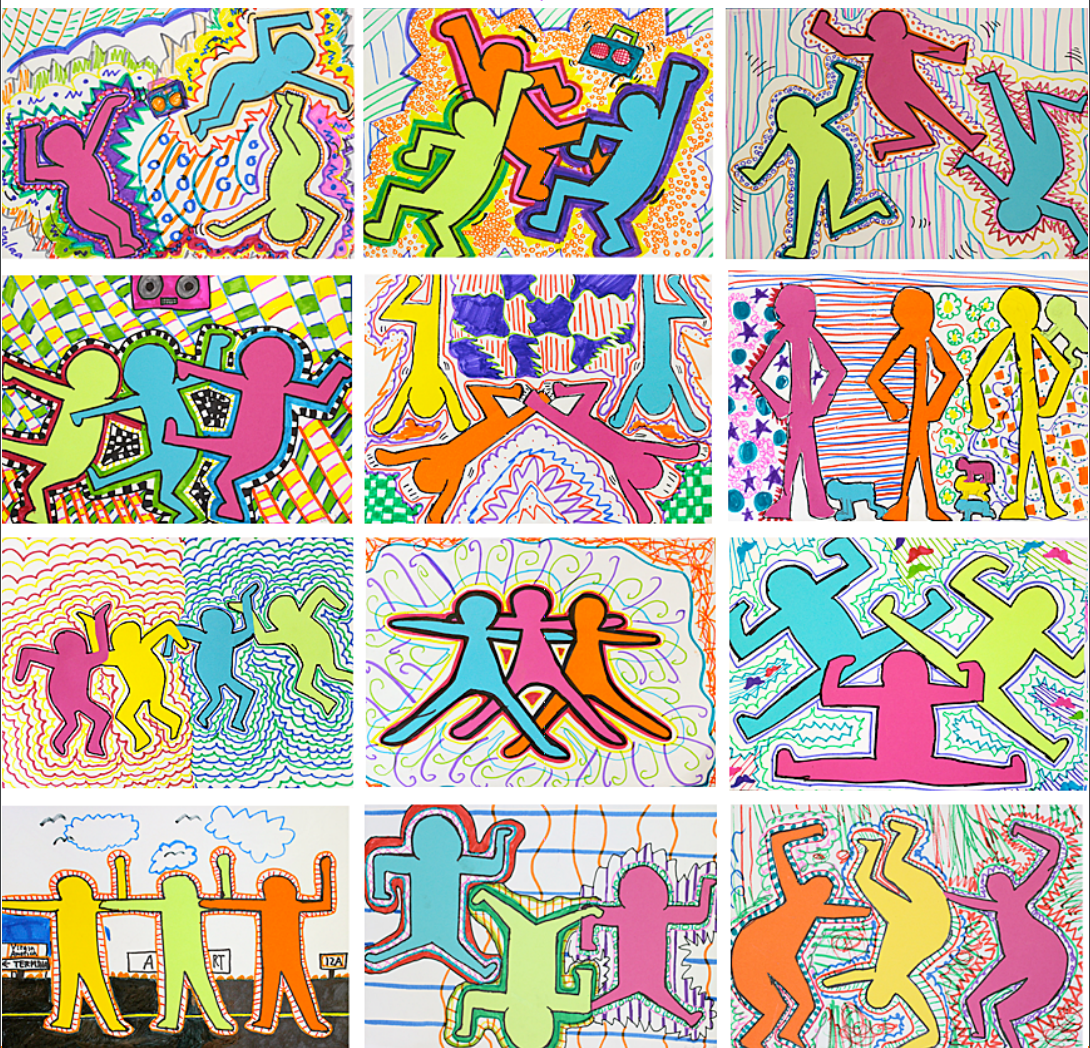
Haring’s figures are often outlined in thick, unbroken lines. Radiating marks around their bodies suggest movement, sound or an invisible force. Among his best-known images are the radiant baby, the barking dog and groups of dancing figures. These symbols are open to interpretation, but they give his work a distinctive visual rhythm.
The apparent simplicity of the images is carefully constructed. Haring drew on sources ranging from cartoons and comic strips to graffiti, ancient signs and popular culture. His compositions can feel joyful and spontaneous, yet their repeated symbols create a world with its own visual logic. A dog, for instance, might appear comic in one work and threatening in another.
Art with a public purpose
Haring believed art should be accessible, and he often worked outside conventional art spaces. His 1986 mural Crack Is Wack, painted on a handball court wall in East Harlem, was a forceful response to the crack-cocaine crisis. Its bright colours and energetic forms draw attention, while its message is unmistakably urgent.
Social and political concerns became increasingly prominent in his work. He addressed racism, nuclear anxiety, apartheid and the abuse of power, using images that could be understood quickly but were not always comfortable to confront. Haring’s public art joined visual immediacy with direct advocacy.
After being diagnosed with HIV, Haring also used his work to challenge stigma and raise awareness about AIDS. In 1989, he created Ignorance = Fear, a poster featuring figures covering their eyes, ears and mouths. The image urges viewers not to remain silent or uninformed. Haring established the Keith Haring Foundation in 1989 to support organisations working with children and communities affected by HIV and AIDS, as well as arts education.
Taking art beyond the art world
In 1986, Haring opened the Pop Shop in New York’s SoHo district, selling items bearing his designs, including T-shirts, badges and posters. He wanted people to be able to own his work without needing to buy an expensive original. The shop reflected his commitment to making art part of everyday life, although it also raised questions about the relationship between artistic ideals and commercial culture.
Haring’s work continued to appear in galleries and major public projects around the world. He painted murals, collaborated with other artists and musicians, and produced works in a range of formats. Across these settings, he retained a visual style that was immediate and widely legible.
A lasting influence
Keith Haring died in 1990, aged 31. His career was brief, but his images remain familiar because they balance visual simplicity with emotional and political complexity. They invite people in through colour, humour and movement, then ask them to look more closely at the issues beneath the surface.
Haring’s legacy lies not only in his iconic figures but also in his idea of what art could do: occupy public space, communicate across social boundaries and bring attention to urgent causes. His work still feels alive because it treats art not as something separate from the world, but as a way of responding to it.
Exploring Keith Haring: An Insight into His Art, Symbols, and Social Impact
- Who was Keith Haring?
- What is Keith Haring best known for?
- What do the symbols in Keith Haring’s art mean?
- Why did Keith Haring make subway drawings?
- What themes did Keith Haring explore in his art?
- What is Keith Haring’s most famous artwork?
- Where can you see Keith Haring’s artwork?
- How did Keith Haring use his art to raise awareness of social issues?
Who was Keith Haring?
Keith Haring (1958–1990) was an American artist known for his bold, energetic images of outlined figures, radiant babies and barking dogs. He rose to prominence in 1980s New York, first gaining attention for chalk drawings in subway stations before creating paintings, murals and public artworks around the world. Drawing inspiration from street culture and popular art, Haring made work that was accessible and visually striking, while also addressing issues such as racism, drug use and the AIDS crisis.
What is Keith Haring best known for?
Keith Haring is best known for his bold, colourful art featuring outlined figures, radiant babies and barking dogs. Emerging from New York’s 1980s street-art scene, he first gained attention for his chalk drawings on subway advertising panels. His instantly recognisable style made art accessible to a wide audience, while his work often addressed social issues such as racism, drug use and HIV/AIDS.
What do the symbols in Keith Haring’s art mean?
Keith Haring’s symbols do not always have one fixed meaning: their interpretation often depends on the surrounding images and context. The radiant baby is commonly associated with innocence, hope and potential, while the barking dog can suggest authority, aggression or abuse of power. Dancing figures and radiating lines often convey movement, energy and human connection. Haring used these bold, recognisable motifs to make his work accessible, while inviting viewers to consider themes such as love, inequality, fear and social change.
Why did Keith Haring make subway drawings?
Keith Haring made subway drawings because he saw the New York underground as a public gallery, where his art could reach people who might never visit a museum. From 1980, he used white chalk to draw quickly on the black paper covering unused advertising panels, developing his bold, simple visual language in a busy, everyday setting. The drawings let him practise, connect with a wide audience and make art accessible beyond the traditional gallery world.
What themes did Keith Haring explore in his art?
Keith Haring explored themes of love, unity, joy and human connection, alongside urgent social and political issues. His work addressed racism, inequality, nuclear anxiety, drug abuse and the AIDS crisis, often using bold, accessible symbols to encourage people to think and take action. While his lively figures and bright colours can seem playful, they frequently carry a serious message about compassion, justice and the struggles of contemporary life.
What is Keith Haring’s most famous artwork?
There is no single agreed answer, but Keith Haring’s Radiant Baby is often considered his most recognisable image. The crawling baby surrounded by rays became one of his signature symbols, appearing in drawings, paintings and public works. His 1986 mural Crack Is Wack is also among his best-known works, particularly for its bold public message.
Where can you see Keith Haring’s artwork?
Keith Haring’s artwork can be seen in major museums and galleries around the world, including the Museum of Modern Art in New York, the Broad in Los Angeles and the Stedelijk Museum in Amsterdam. In New York, his public mural Crack Is Wack remains on view in Harlem’s Crack Is Wack Playground. His work also appears in temporary exhibitions and public collections, so check museum websites and exhibition listings for current displays.
How did Keith Haring use his art to raise awareness of social issues?
Keith Haring used bold, easily recognised images and public spaces to bring social issues to a wide audience. His subway drawings and murals made art accessible beyond galleries, while works such as Crack Is Wack addressed drug addiction and Ignorance = Fear challenged silence and misinformation about HIV and AIDS. Through posters, public projects and his foundation, Haring also supported education and community organisations, combining striking visual messages with practical advocacy.