

Basquiat Art: The Bold Vision That Changed Contemporary Art
Jean-Michel Basquiat: The Art That Refused to Be Ignored
Jean-Michel Basquiat made art that demanded attention. His paintings and drawings combine forceful brushwork, vivid colour, handwritten phrases and recurring symbols. They can appear spontaneous at first glance, but their layered references reveal a searching engagement with history, identity, race, power and the art world itself.
Basquiat was born in New York City in 1960 to a Haitian-American father and a Puerto Rican mother. Before becoming internationally recognised as an artist, he gained notice as a teenager for SAMO, a series of cryptic phrases written on walls around Lower Manhattan with his friend Al Diaz. The project introduced a voice that would remain central to his work: sharp, witty and sceptical of authority.
A distinctive visual language
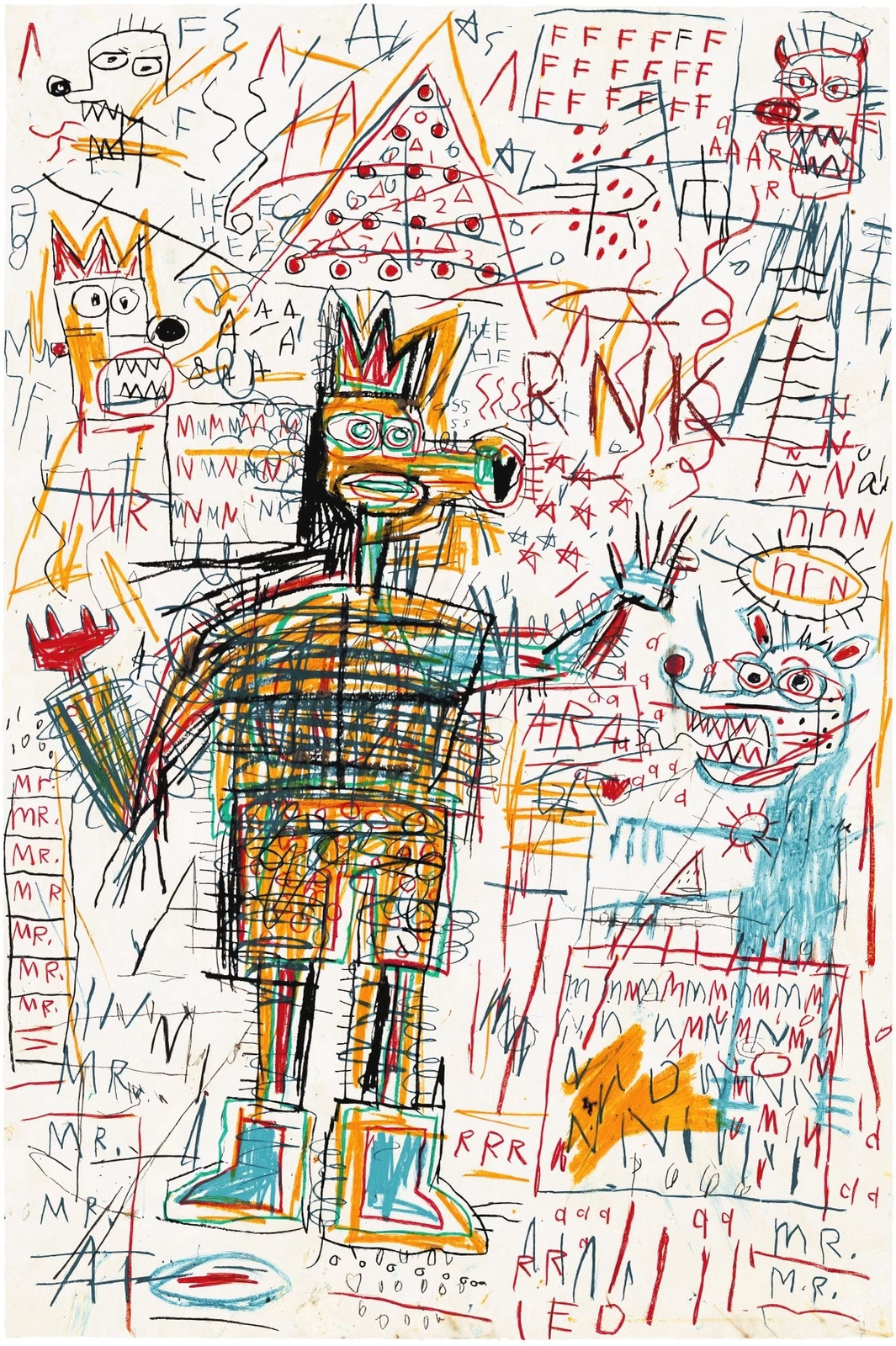
Basquiat’s paintings often bring together figures, crowns, bones, arrows, diagrams, words and fragments of text. Some images are crossed out, repeated or left partly unfinished. This gives the work an urgent, unsettled quality, as though several ideas are competing for space on the same surface.
The crown is among his best-known motifs. It can suggest royalty, achievement or the recognition denied to people and histories pushed to the margins. Basquiat also returned to the human body, using skeletal forms and exposed anatomy to explore vulnerability, mortality and the physical realities of life.
His visual language drew on a wide range of sources, including jazz, boxing, anatomy, African and Caribbean history, popular culture and the work of earlier artists. Rather than keeping these references separate, he brought them together in compositions that feel both personal and expansive. His paintings ask viewers to look closely, read between the lines and question whose stories are remembered.
Race, history and power
Race and representation are central to many readings of Basquiat’s art. He repeatedly placed Black figures at the heart of his work, portraying them as musicians, athletes, historical figures and protagonists. In doing so, he challenged a culture in which Black people were often excluded from the histories told by museums and mainstream art institutions.
Works such as Defacement (The Death of Michael Stewart) respond to racial violence and the treatment of Black Americans. Elsewhere, Basquiat’s references to figures such as jazz musician Charlie Parker connect individual lives to broader histories of creativity, exploitation and fame. His paintings can be playful and energetic, but that energy often sits alongside anger and grief.
From the street to the gallery
Basquiat moved quickly from New York’s downtown art scene to international recognition. He exhibited in galleries, worked alongside established artists and collaborated with Andy Warhol. His rise brought acclaim, but it also placed him within a commercial art world that his work could scrutinise even as it became part of the market.
Basquiat died in 1988, aged 27. His short career has since become the subject of extensive exhibitions, books and public debate. The continuing popularity of his work can sometimes obscure its complexity, reducing it to a handful of recognisable images. Yet the paintings resist easy interpretation. Their words and symbols rarely settle into one fixed meaning.
A lasting influence
Basquiat’s legacy lies not only in his instantly recognisable style, but in the questions his work continues to raise. Who gets to shape cultural history? How are Black lives represented? What happens when personal expression meets commercial success? His art offers no simple answers. Instead, it turns these questions into something visible, energetic and difficult to look away from.
More than three decades after his death, Basquiat’s work remains compelling because it holds contradiction in view: beauty and brutality, humour and seriousness, spontaneity and research. It speaks in fragments, but those fragments form a powerful record of an artist intent on being heard.
Exploring Basquiat: 8 Key Insights into His Iconic Art
- Look for crowns, a recurring symbol of dignity and power.
- Notice how words and images compete for attention.
- Explore themes of race, identity and inequality.
- Watch for anatomy-inspired drawings and skeletal forms.
- Look for crossed-out words that remain visible.
- Spot influences from jazz, comics and street art.
- Notice the energetic marks and layered surfaces.
- Consider the work’s context in 1980s New York.
Look for crowns, a recurring symbol of dignity and power.
When looking at Basquiat’s art, keep an eye out for crowns: one of his most recognisable recurring symbols. Often interpreted as emblems of dignity, achievement and power, they can also suggest a way of honouring people—particularly Black figures—whose importance has been overlooked or undervalued. Their meaning can shift from one work to another, so consider who wears the crown and what else is happening in the painting.
Notice how words and images compete for attention.
Notice how words and images compete for attention in Basquiat’s art. Handwritten phrases, repeated symbols and bold figures often crowd the same surface, pulling the eye in several directions at once. Rather than guiding you towards a single meaning, this visual tension reflects the work’s urgency and invites you to pause, look again and decide which details speak loudest.
Explore themes of race, identity and inequality.
Basquiat’s art invites viewers to explore race, identity and inequality through vivid imagery, layered words and powerful historical references. His depictions of Black figures challenge whose stories are recognised and remembered, while recurring symbols and figures draw attention to racism, exclusion and the unequal distribution of power. Looking closely at these themes can reveal how his work blends personal expression with a wider critique of society.
Watch for anatomy-inspired drawings and skeletal forms.
Look out for anatomy-inspired drawings and skeletal forms in Basquiat’s art. Bones, skulls and exposed body structures appear alongside expressive figures and bold marks, giving his work a raw, urgent quality. These images can suggest vulnerability and mortality, while also reflecting his interest in anatomy, history and the human body.
Look for crossed-out words that remain visible.
Look for words that Basquiat has crossed out but left visible. Rather than erasing them completely, he often lets the marks draw attention to the words beneath, inviting viewers to pause and consider why they have been obscured. This tension between concealment and visibility is part of what makes his paintings feel so layered and thought-provoking.
Spot influences from jazz, comics and street art.
Look closely at Basquiat’s paintings and you may spot the rhythms of jazz, the bold imagery of comics and the raw energy of street art. References to musicians and musical improvisation lend his work a lively, syncopated feel, while simplified figures, symbols and words can recall comic-book panels. His early graffiti practice also shaped the loose marks and handwritten text that run across many of his canvases. These influences overlap rather than sit apart, giving the work its distinctive sense of movement and layered meaning.
Notice the energetic marks and layered surfaces.
Look closely at Basquiat’s energetic marks and layered surfaces. Quick, expressive lines, bold colours and overlaid words can make a painting feel as if it is unfolding before your eyes. Instead of reading every mark in isolation, notice how the layers build tension, create rhythm and bring different ideas into conversation.
Consider the work’s context in 1980s New York.
Consider Basquiat’s work in the context of 1980s New York, a city shaped by vibrant street culture, racial inequality, economic hardship and a rapidly changing art scene. His paintings draw on the energy of downtown music, graffiti and nightlife, while confronting histories and power structures often overlooked by mainstream culture. Understanding this setting can help reveal why his mix of words, symbols and bold imagery feels both urgent and deeply rooted in its time.