

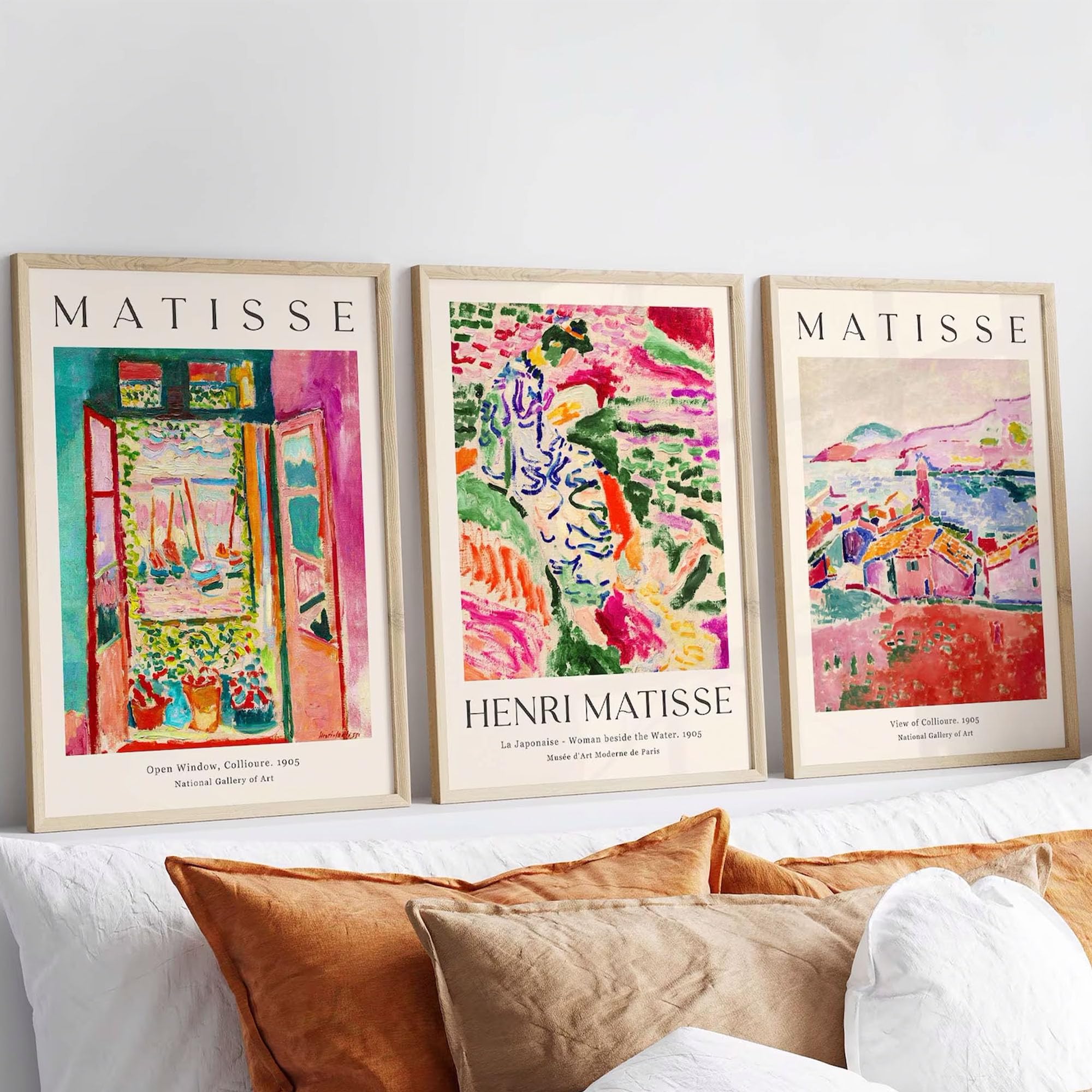
Henri Matisse Prints: The Art of Colour, Line and Simplicity
Henri Matisse Prints: Colour, Line and the Art of Simplicity
Henri Matisse is celebrated for paintings that seem to radiate colour, but printmaking was an important part of his artistic life too. From delicate portrait studies to bold, simplified figures, his prints reveal an artist continually testing how much could be expressed with a line, a shape or a carefully chosen patch of colour.
Matisse worked with several printmaking techniques, including etching, drypoint, lithography and linocut. He also made extensive use of stencil printing for Jazz, his celebrated artist’s book of 1947. These different processes suited his changing interests, yet the prints share qualities that are unmistakably his: clarity, rhythm and a remarkable economy of means.
A lifelong interest in printmaking
Matisse’s printmaking developed alongside his work in painting, drawing and sculpture. He returned to printed media throughout his career, often using them to explore a subject in a different way from the one he had chosen for a painting. Printmaking encouraged him to concentrate on essentials. A few contours could suggest a face; a repeated curve could give a figure movement.
Portraits were a recurring subject. Matisse made prints of family members, friends, writers and fellow artists, often favouring a direct, uncluttered line over elaborate detail. His prints also include nudes, dancers, interiors and still-life subjects. Across these works, the human figure and the expressive potential of line remain central.
The bold world of Jazz
Among Matisse’s best-known print projects is Jazz, published in 1947. The book brings together colourful designs based on forms cut from painted paper. Matisse arranged and rearranged the shapes until they achieved a sense of balance and movement, then worked with the printer Mourlot to reproduce them using the pochoir, or stencil, process.
The vivid plates include performers, acrobats, animals and abstract patterns. Their apparent simplicity is deceptive: each shape plays a precise role in the composition. Jazz also reflects Matisse’s late-career embrace of paper cut-outs, a practice that allowed him to work directly with colour and form.
Although Jazz is often discussed alongside Matisse’s prints, its images are stencil reproductions of cut-paper designs rather than conventional etchings or lithographs. That distinction can matter to collectors, but it does nothing to diminish the book’s artistic importance.
Why Matisse’s prints still appeal
Matisse’s prints offer an intimate view of his visual language. Without the layered surfaces of an oil painting, the viewer can focus on the character of a line or the relationship between positive and negative space. Even the most reduced image feels lively: a face can seem to turn towards the viewer, while a sweeping contour can make a static figure feel poised to move.
They also show how Matisse explored repetition and variation. A subject might appear in a different medium or be revisited through a fresh arrangement of lines. Rather than simply reproducing the effects of his paintings, his prints form a distinctive body of work with its own range and character.
Collecting Henri Matisse prints
The word “print” can describe several different things, so it is worth checking exactly what is being offered. An original print is made through a printmaking process, such as lithography or etching. A reproduction, by contrast, is a later printed copy of an existing image. Matisse’s designs have been reproduced widely, including as posters and decorative editions.
When assessing a work, consider its medium, publication details, edition information, condition and provenance. A signature or edition number can be useful, but it should not be treated as proof of authenticity on its own. For a significant purchase, seek advice from a reputable dealer or an independent print specialist, and consult authoritative catalogues and institutional records where available.
A lasting lesson in simplicity
Henri Matisse’s prints demonstrate that simplicity is not the same as ease. Their spare lines and striking shapes are the result of careful decisions about what to include and what to leave out. Whether encountered in a portrait, an etching or the vibrant pages of Jazz, they invite viewers to look closely—and to discover just how much feeling a simple mark can hold.
Exploring Henri Matisse Prints: Common Questions Answered
- What disability did Henri Matisse have?
- Are Matisse prints worth anything?
- What is a Matisse painting worth?
- Is Matisse copyright free?
- How do you authenticate a Matisse?
- Where can I buy authentic Matisse prints?
What disability did Henri Matisse have?
Henri Matisse did not have a disability from birth. In 1941, following surgery for abdominal cancer and subsequent health complications, his mobility became severely limited, and he later used a wheelchair. He continued to work, developing his cut-paper technique and directing assistants to help arrange and attach the shapes.
Are Matisse prints worth anything?
Yes, some Henri Matisse prints can be valuable, but prices vary widely. Value depends on factors such as whether the work is an original print or a later reproduction, its medium, edition, condition, provenance and market demand. Signed or rare examples may attract higher prices, while widely produced posters and reproductions are generally worth less. For an accurate assessment, consult a reputable print specialist or auction house.
What is a Matisse painting worth?
The value of a Matisse painting can range from thousands to millions of pounds, depending on factors such as its date, medium, size, subject, condition, provenance and authenticity. Major oil paintings with a strong exhibition history may achieve exceptional prices, while drawings and prints are generally valued differently—and prints can vary widely according to whether they are authentic, limited-edition works or later reproductions. For a reliable estimate, consult recent sales of comparable works and seek an assessment from a reputable auction house or independent art specialist.
Is Matisse copyright free?
In the UK, Henri Matisse’s original works are generally in the public domain: he died in 1954, so copyright normally expired at the end of 2024. However, copyright can differ in other countries, and a photograph or digital image of a print may have separate rights or usage conditions. Before reproducing an image commercially or online, check the rules where it will be used and the terms supplied by the image’s source.
How do you authenticate a Matisse?
Authenticating a Henri Matisse print requires more than checking for a signature or edition number, as both can be copied and many legitimate prints are unsigned. Start by identifying the printmaking technique and comparing the work’s paper, dimensions, signature, edition details and publication history with reliable catalogue records. Provenance and any documentation can help, but should be independently verified. For a valuable work, consult a reputable print specialist or auction-house expert and seek a written assessment; no single certificate or visual check guarantees authenticity.
Where can I buy authentic Matisse prints?
Authentic Henri Matisse prints can be found through established auction houses, reputable fine-art dealers and specialist print galleries. Museum shops and trusted art publishers may also offer authorised reproductions, though these are different from original prints. Before buying, check the work’s medium, edition details, provenance and condition, and request a certificate or other supporting documentation where available. For a valuable purchase, seek an independent opinion from a qualified print specialist, as signatures and certificates alone do not guarantee authenticity.