

Mondrian Art: The Power of Lines, Colour and Balance
Mondrian Art: The Power of Lines, Colour and Balance
Few artists are as instantly recognisable as Piet Mondrian. His paintings of black lines, white spaces and blocks of primary colour have become familiar far beyond the galleries where they first appeared. Yet Mondrian’s art was not simply a distinctive style. It was the result of a lifelong search for a visual language that could express order, balance and the deeper structure of the world.
Who was Piet Mondrian?
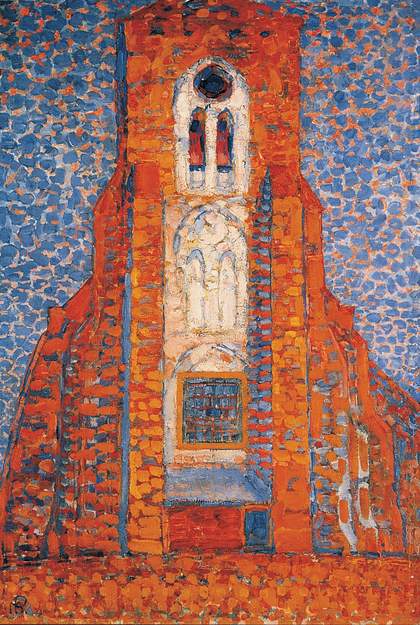
Piet Mondrian was born in the Netherlands in 1872. He began his career as a painter of landscapes, windmills and other subjects drawn from the Dutch countryside. These early works were more naturalistic than the geometric paintings for which he is now famous, though they already show his interest in structure, rhythm and the effects of light.
Over time, Mondrian’s work became increasingly simplified. He experimented with Impressionist and Symbolist approaches, then encountered Cubism during a period in Paris. Cubist painting encouraged him to break familiar forms into planes and patterns. Mondrian took this idea further, gradually moving away from depicting recognisable objects altogether.
From landscapes to abstraction
Mondrian’s move towards abstraction was a process rather than a sudden change. In paintings of trees, for example, branches and trunks become increasingly angular and interwoven. The subject remains recognisable at first, but its natural details are gradually reduced to lines, shapes and relationships across the canvas.
By the 1910s, Mondrian was developing a style he called Neoplasticism, meaning a new way of representing form. He sought to remove the particular details of the visible world and create compositions based on what he considered universal elements: straight horizontal and vertical lines, rectangular shapes, and carefully balanced colour.
What makes a Mondrian painting?
Mondrian’s mature works are built from a small number of elements. Black lines divide the canvas into rectangles and squares, while areas of white, red, blue and yellow provide contrast. The lines do not always form a regular grid, and the coloured areas vary in size and position. This gives each painting a distinct sense of movement and equilibrium.
The apparent simplicity can be deceptive. Mondrian adjusted the width, length and placement of lines with great care, as well as the proportions of each colour field. A small change could alter the balance of the whole composition. Rather than placing an image at the centre, he made the relationships between its parts the main subject.
White space is just as important as colour. It is not an empty background but an active part of the composition, balancing the black lines and brighter blocks. The result can feel both orderly and dynamic: the grid offers structure, while unequal shapes and intervals keep the eye moving.
De Stijl and a new visual language
Mondrian was closely associated with De Stijl, a Dutch art and design movement founded in 1917. Its name means “The Style”. Artists and designers connected with the movement explored how simplified forms might create a clear, harmonious visual language suited to a changing modern world.
Mondrian’s ideas also reached beyond painting. The principles of De Stijl influenced architecture, furniture, graphic design and typography. Its emphasis on clean lines and geometric forms became part of a wider conversation about modern design, although Mondrian’s own paintings were not merely plans for practical interiors. They were works of art with their own carefully considered visual logic.
Why Mondrian’s art still matters
Mondrian’s paintings continue to appeal because they are both accessible and open to interpretation. Their colours and shapes are easy to recognise, yet the balance between them can be absorbing to look at. Viewers may notice different qualities: precision, energy, calm, tension or even a sense of rhythm.
His influence can be seen in countless areas of visual culture, from fashion and advertising to product design and digital graphics. That familiarity has sometimes made the work seem simple, but looking closely reveals how much thought lies behind each composition. The paintings ask a deceptively direct question: how can a few basic elements create a complete and compelling whole?
A lasting art of balance
Mondrian’s achievement was to turn reduction into a form of invention. By narrowing his visual vocabulary, he found new ways to explore proportion, colour and movement. His art does not describe a landscape or tell a story in the usual sense. Instead, it makes balance itself visible.
More than a century after Mondrian began developing his abstract language, his work remains strikingly modern. Its enduring appeal lies in the tension between freedom and order: every line and colour seems controlled, yet the composition continues to move and breathe.
Mondrian’s Art: 8 Frequently Asked Questions
- What is Mondrian’s art style called?
- What is Piet Mondrian’s most famous painting called?
- Is Mondrian art abstract?
- What type of art is Mondrian known for?
- What is Piet Mondrian most famous painting called?
- What is the Mondrian art problem?
- Why is Mondrian art so expensive?
- What is Mondrian style called?
What is Mondrian’s art style called?
Mondrian’s mature art style is called Neoplasticism (also known by the Dutch term Nieuwe Beelding). Developed in the early 20th century, it uses simplified geometric forms, straight horizontal and vertical lines, and a limited palette of primary colours, black, white and grey. Mondrian became closely associated with the De Stijl movement, which shared many of these principles.
What is Piet Mondrian’s most famous painting called?
Piet Mondrian’s most famous works are his abstract compositions of black grid lines and blocks of primary colour, rather than a single universally agreed masterpiece. One of the best-known is Composition with Red, Blue and Yellow (1930), celebrated for its precise balance of red, blue, yellow, white and black. The title is sometimes given in slightly different forms, but it refers to Mondrian’s instantly recognisable geometric style.
Is Mondrian art abstract?
Yes, Mondrian’s best-known works are abstract: they do not depict recognisable people, places or objects. Instead, they use straight horizontal and vertical lines, geometric shapes and primary colours to explore balance, rhythm and composition. His early paintings were more representational, often showing landscapes, but over time he simplified these subjects until he developed the distinctive abstract style associated with his name.
What type of art is Mondrian known for?
Piet Mondrian is best known for abstract art, particularly his geometric paintings made from straight black lines, white spaces and blocks of primary colour. A leading figure in the De Stijl movement, he developed a style called Neoplasticism, reducing forms to horizontal and vertical lines and carefully balanced rectangles.
What is Piet Mondrian most famous painting called?
Piet Mondrian is perhaps best known for Composition with Red, Blue and Yellow (1930), a striking abstract painting made up of black lines and blocks of primary colour against a white ground. It captures the pared-back style he developed, though no single work is universally agreed to be his most famous. His later compositions, including Broadway Boogie Woogie (1942–43), are also widely celebrated.
What is the Mondrian art problem?
The “Mondrian art problem” is not a recognised art-historical problem; the phrase usually refers to a mathematical puzzle inspired by Piet Mondrian’s geometric paintings. It asks how a rectangle or square can be divided into smaller rectangular blocks while meeting particular rules—for example, ensuring that no two blocks have the same area or finding the most balanced arrangement. These puzzles echo Mondrian’s grids and colour blocks, but they are modern mathematical challenges rather than problems posed by the artist himself.
Why is Mondrian art so expensive?
Mondrian’s art can be so expensive because his paintings are rare, historically important and closely associated with the development of modern abstraction. His most sought-after works come from key periods in his career and are held in major museums or private collections, so they seldom appear at auction. Prices are also shaped by strong international demand, the artist’s enduring influence on design and culture, and the unique balance and precision of each composition. Not every work linked to Mondrian commands the same value, however: attribution, date, condition, provenance and significance all affect its price.
What is Mondrian style called?
Mondrian’s distinctive style is called Neoplasticism, or Nieuwe Beelding in Dutch, meaning “new plastic art”. It is also closely associated with De Stijl, the Dutch art movement of which he was a leading member. The style uses geometric forms, straight horizontal and vertical lines, and a restricted palette—most famously red, yellow, blue, black and white—to create carefully balanced abstract compositions.